I’ve been thinking about how to swallow.
Not because I’ve forgotten how. At least, I don’t think I have. It’s just that I’ve started noticing it.
It happened while drinking something one day about a year ago. I took a fairly large drink and, somewhere between the front of my mouth and my throat, realized that the whole thing didn’t seem particularly interested in becoming one swallow.
So I moved half of the liquid toward the front of my mouth, around my teeth, and swallowed it in two smaller portions. That worked better.
And for some reason, this bothered me.
There’s something unsettling about discovering that an action you’ve performed thousands of times might have a technique you never consciously learned.
Swallowing is supposed to be automatic. You put something in your mouth, your body takes over, and eventually whatever you’ve consumed arrives somewhere farther south. There is no instruction manual. No conscious sequence of movements. No little voice in your head saying, All right, prepare the throat.
You just swallow. Until you don’t quite.
I’ve noticed that a particularly large gulp sometimes seems to get caught somewhere in the process. Not exactly choking. Not exactly a hiccup. More like the swallowing motion itself pauses in the back of my throat, suspended for a moment between this is fine and something has gone slightly wrong.
Other times, I simply need to swallow more than once to accommodate the amount of liquid I’ve taken in.
And I’ve begun noticing that dividing a large gulp into two or three consecutive swallows often makes the process easier.
It’s a remarkably small thing, but I wonder if that’s why I’ve noticed it.
Because as we get older, some of the things we once took for granted begin to reveal themselves. Not necessarily because they stop working. Sometimes they just stop being invisible.
For most of my life, swallowing was nothing. It wasn’t an activity I performed. It was something that just happened.
Now there are moments when I can feel the mechanics of it. I feel where the liquid is sitting. I sense the difference between a comfortable amount and an ambitious one. I recognize that moment when I have taken slightly more than my throat seems prepared to process in a single transaction.
And once you become aware of something like that, it’s difficult not to wonder how long your body has been doing it without you.
There are countless processes happening inside us that we rarely experience consciously:
- Our hearts beat.
- Our lungs exchange gases.
- Our stomachs move things around.
- Our eyes constantly adjust to changing light.
- Our bodies maintain temperatures, pressures, balances, and chemical concentrations with a complexity that would be almost incomprehensible if we had to consciously manage any of it.
And yet we tend to experience all of this as simply being alive. We think of ourselves as the person making decisions while the body is the thing carrying them out.
But the older I get, the less convincing that distinction seems. My body is constantly making decisions without consulting me:
- When I reach for a glass, I don’t calculate the angle of my elbow or the amount of force required to lift it.
- When I walk across a room, I don’t consciously coordinate every muscle involved in keeping me upright.
- When something touches my skin, I don’t decide whether the sensation should feel hot or cold.
- And when I swallow, I don’t tell my throat what to do.
Until, occasionally, something changes. Then the invisible machinery becomes visible.
Maybe that’s part of aging that isn’t discussed very often. We tend to think about aging in terms of obvious changes. Gray hair. Wrinkles. Less energy. A slower recovery after doing something that seemed perfectly reasonable at the time. But there may be another kind of aging that is much quieter.
It’s the gradual transition from having a body you rarely think about to having a body that occasionally reminds you that it is there. A movement doesn’t feel quite the same. A joint makes a noise. A familiar physical task requires a little more attention. A large gulp becomes two smaller ones.
None of these things necessarily means anything dramatic. In isolation, they’re almost meaningless, but they are reminders. The body we inhabit isn’t static. It’s been changing since the moment we were born. We’ve simply been too busy living inside it to notice most of the changes.
There’s also something interesting about the difference between swallowing and drinking quickly.
When someone chugs a beverage, they seem to bypass much of the deliberateness involved in ordinary drinking. The throat opens, the liquid moves, and the whole process becomes almost continuous. But that’s not really what I’m doing. I’m not trying to chug.
I’m trying to swallow a normal drink the way I always have, only to discover that what once felt like a single action may now work better as several.
That distinction seems strangely significant. Because it isn’t really about the liquid. It’s about adaptation. At some point, we learn that the easiest way to continue doing something is to do it slightly differently.
We don’t necessarily announce the change. We don’t mark the occasion. We simply adjust.
We take smaller bites. We slow down. We use the handrail. We stand up more carefully. We give ourselves another moment before moving.
And perhaps the most important part is that none of these adjustments necessarily represents defeat.
There is a tendency to think of aging as a gradual process of losing things.
- Strength.
- Speed.
- Flexibility.
- Endurance.
- Certainty.
But adaptation is another way of describing the same process. The body changes, and we change with it. Sometimes that change is so subtle that all we notice is that something that used to be easy now works better when approached differently.
Which brings me back to swallowing.
I don’t particularly like having to think about it. I’d prefer that swallowing remain where it has always been: somewhere beneath my awareness, quietly doing its job. But perhaps that’s the wrong way to look at it.
Maybe noticing something as ordinary as swallowing is an opportunity to recognize just how much of our existence has always been happening outside our awareness.
We spend an enormous amount of time thinking about what we are going to do, what we have done, what we should have done, and what might happen next. Meanwhile, our bodies are carrying on with thousands of tiny negotiations every second. Most of them never reach consciousness.
Until one does.
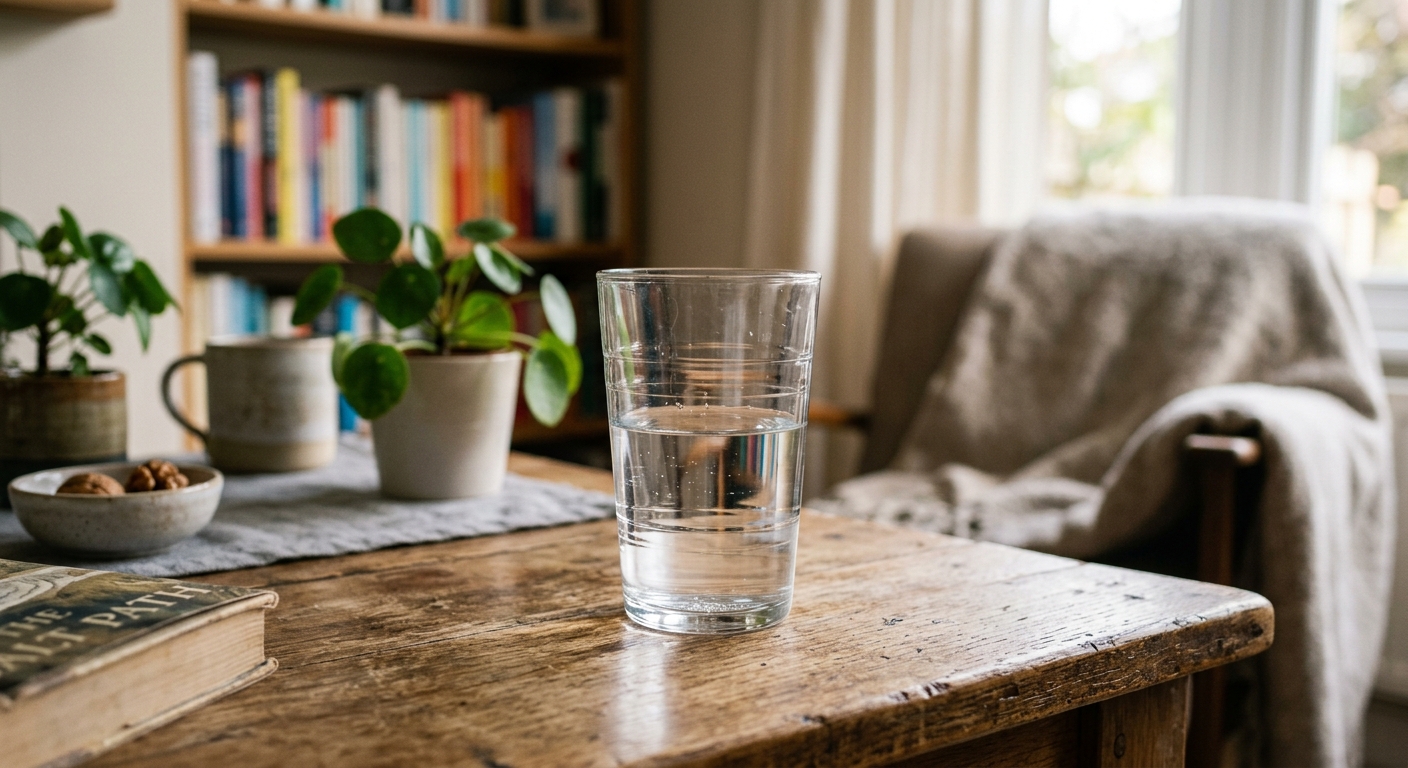
And sometimes all it takes is a mouthful of water.
- Take a drink.
- Move it back.
- Swallow.
- Maybe swallow again.
And for a brief moment, you become aware of something that’s been happening your entire life. It’s a strange thing to discover that you’re still learning how to use a body you’ve occupied for decades. But maybe that’s what having a body is.
Not owning a finished machine, but continuously adapting to one that is changing while you live inside it.
Even when the change is nothing more dramatic than realizing that a gulp works better in two swallows than one. I suppose I’ll take that as a reminder.
Slow down. Pay attention.
And don’t assume that because you’ve been doing something your entire life, you’ve stopped learning how to do it.