
An exercise in seeing how far language can go before it trips over its own tongue.
There are certain thoughts that enter your head uninvited, take up residence, and refuse to leave until you’ve given them considerably more attention than they deserve. This morning, mine was about rhyming.
Not poetry, exactly. Not the sort of carefully constructed verse that has inspired, entertained, and occasionally confounded humanity for centuries. Just the peculiar possibility of cramming an unreasonable number of rhyming words into a single sentence while still managing to say something intelligible.
Poets have certainly explored this territory before. Rhyming couplets, internal rhymes, monorhymes, multisyllabic rhymes — there’s an entire vocabulary devoted to making words sound alike in artistically satisfying arrangements.
But I wasn’t particularly interested in artistry. I wanted density.
Specifically, how many exact rhymes could I squeeze into a grammatically correct, reasonably plausible statement before the whole thing collapsed into gibberish?
Naturally, at that hour of the morning, my first thought went to food.
The Pretzel Proposition
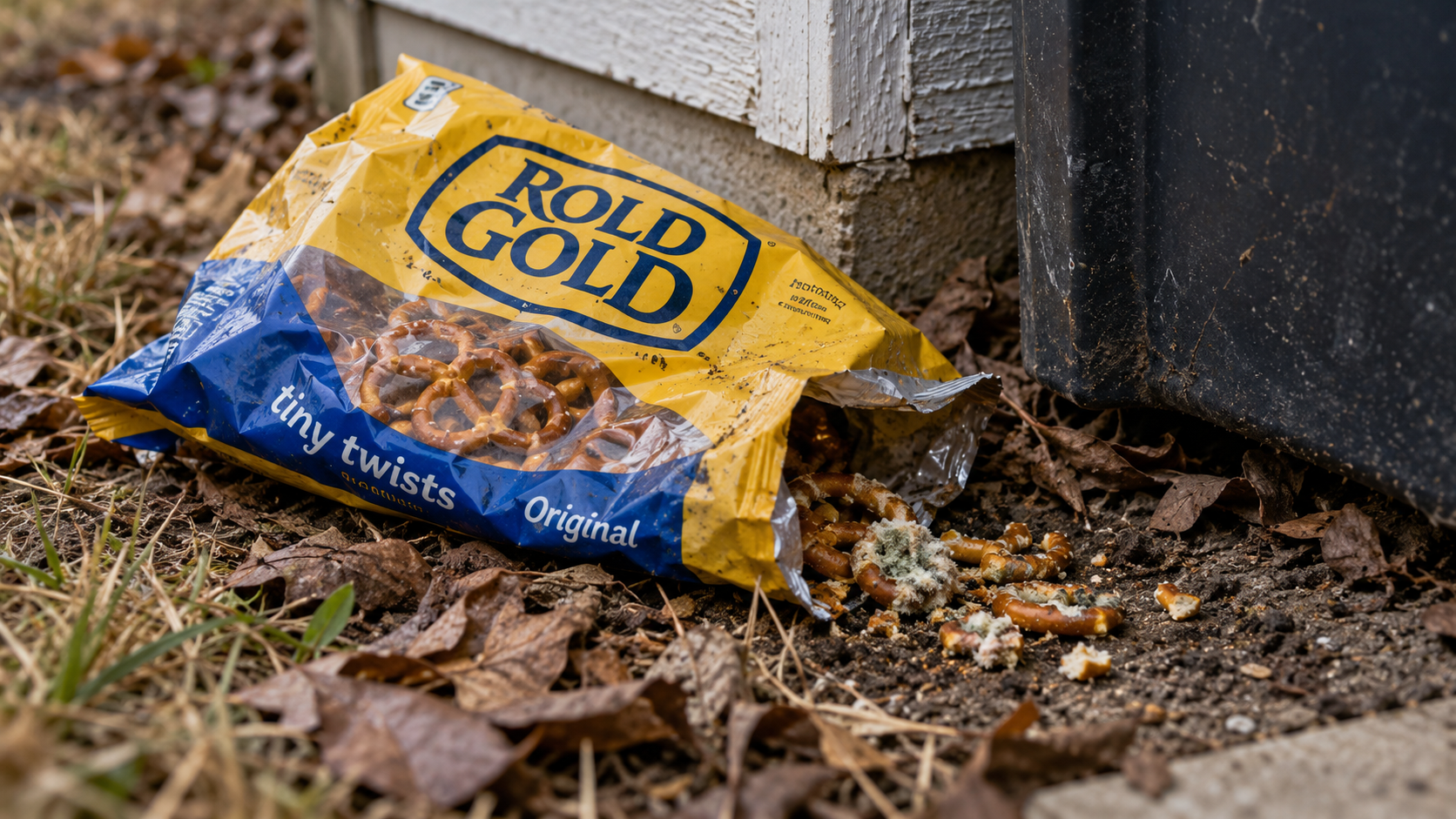
Imagine discovering an old bag of brand name pretzels in the pantry. They’ve been there long enough to develop a thriving civilization of mold, so you sensibly toss the bag into the outdoor trash.
Except you miss. The bag falls behind the garbage bin, where it remains undiscovered for several months. Winter arrives. Eventually, while moving the bin, you uncover the forgotten pretzels, now both moldy and cold.
Congratulations. You’ve found:
Old, cold Rold Gold mold.
Five consecutive words. Five exact rhymes. One perfectly reasonable, if somewhat disgusting, description of an actual thing that could exist.
There’s something deeply satisfying about this. The words aren’t merely assembled because they rhyme. Each contributes meaningful information. The pretzels are old. They’re cold. They’re Rold Gold. And they’re moldy.
(Well, technically, the mold is mold, and the pretzels are the original host civilization, but you get the idea.)
More importantly, nothing about the phrase violates the rules of English. It’s not quite the sort of expression you’d expect to hear in casual conversation, but it could conceivably arise naturally under the right circumstances.
Admittedly, those circumstances require a particular brand of pretzels, an unfortunate garbage disposal incident, several months of neglect, and a specific seasonal timeline. But we’re dealing in possibilities here, not probabilities.
And this raises an interesting question: could we do better?
The Difference Between Rhyming and Making Sense
Anyone can string together a collection of rhyming words.
Cold, bold, fold, gold, hold, mold, old, rolled, sold, told.
There. Ten of them.
But what have we accomplished? Nothing more impressive than remembering a few words that sound alike. The challenge is making those words perform actual grammatical work. They need to form a coherent statement. They need subjects, verbs, adjectives, and whatever other parts of speech are necessary to convey a recognizable thought.
Ideally, they should describe something that could conceivably happen in the real world. A sentence that reads like a malfunctioning rhyming dictionary shouldn’t qualify merely because it contains a large number of matching sounds.
Consider:
Hugh knew Sue drew blue shoes.
Six consecutive rhyming words. A complete sentence. Perfectly intelligible.
Hugh has apparently been informed of Sue’s artistic endeavors, which happen to involve the depiction of blue footwear.
The sentence is a little suspicious in its construction, but there’s nothing grammatically wrong with it. All six words rhyme in the relevant pronunciation, all six contribute meaning, and not a single extraneous syllable interrupts the procession.
An impressive accomplishment.
But I remained particularly fond of my pretzels. And I didn’t feel I should insist that every single word rhyme. Sometimes a few ordinary words are necessary to hold the whole thing together. The objective isn’t absolute purity. It’s the greatest concentration of meaningful rhymes in the smallest reasonable amount of language.
There was something about the specificity of Rold Gold that made the original phrase feel less like a deliberately engineered tongue twister and more like an absurd observation waiting to happen.
And then I realized that the pretzels didn’t necessarily have to remain where I’d left them.
Enter the Questionable Charlatan
Suppose someone else discovered my discarded pretzels before I did. Suppose this person, being of questionable moral character and possessing an entrepreneurial spirit unconstrained by either good judgment or public health regulations, decided to retrieve them.
And further suppose, rather than throwing them away as any sensible person would, this enterprising charlatan found an unsuspecting buyer willing to pay for the contaminated merchandise.
If someone subsequently informed me of this transaction, I could quite reasonably report:
I was told he sold the old, cold Rold Gold mold.
Seven.
Seven consecutive exact rhymes, tucked neatly into an eleven-word sentence.
Told. Sold. Old. Cold. Rold. Gold. Mold.
And every one of them is doing something useful.
Told establishes that the information came from someone else. Sold describes the dubious transaction. Old and cold identify the condition of the merchandise. Rold Gold establishes the brand. And mold identifies the biological horror being passed off as a snack.
It’s a complete narrative, with a beginning, a middle, an implied criminal enterprise, and a potential food poisoning lawsuit.
And it contains seven consecutive words ending in the same rhyming sound. I began to suspect that this undertaking required some kind of formal recognition.
Or, failing that, a ridiculously elaborate scoring system.
The Exact Rhyming Nonsense Index
Because there’s no reason to leave a perfectly useless linguistic exercise unquantified, I decided to establish the Exact Rhyming Nonsense Index.
ERNI, for short.
The objective of ERNI is to measure the quality of a rhyming construction according to several criteria: the number of perfect rhymes, their proximity to one another, their density within the sentence, and — most importantly — whether the resulting statement actually means anything.
The scoring system is straightforward enough (at least until someone starts arguing with it). Each rhyming word earns one point. Consecutive words belonging to the same rhyme family earn an additional point for each adjoining pair. Rhyme density earns up to ten points, based on the proportion of words participating in the rhyme.
And because making sense is rather important, the whole thing receives a semantic multiplier of up to two, depending on how coherently the sentence communicates its intended meaning.
Forced phrasing can incur a penalty. Repeated words don’t earn additional rhyme credit.
And proper nouns are permitted, provided they weren’t invented exclusively to manipulate the score. Rold Gold is legitimate. Naming seven fictional characters Bold, Cold, Fold, Gold, Hold, Mold, and Sold would constitute blatant linguistic fraud.
Under this admittedly arbitrary and magnificently unnecessary scoring system, my fraudulent pretzel transaction earns:
38.72 ERNI points.
A respectable showing.
But there’s another wrinkle to consider.
When Rhymes Get Complicated
Not all rhymes are created equal. Consider another hypothetical situation involving a baker of questionable character.
Perhaps this baker has been mistreating his customers. Perhaps he’s been deliberately selling stale pastries. Perhaps he’s been substituting sawdust for flour. His precise transgressions are irrelevant, although apparently the food industry is attracting an unusually large proportion of villains in this investigation.
Whatever his offense, imagine that his attempt at repentance takes a peculiar form:
The baker meant to be viciously malicious, but his contrition was suspiciously delicious.
Now we’ve got something different.
At first glance, the sentence contains fewer rhymes than the pretzel example. But look at the arrangement.
Viciously rhymes with suspiciously.
Malicious rhymes with delicious.
And the words are organized into two corresponding expressions:
Viciously malicious.
Suspiciously delicious.
The first word of each expression rhymes with its counterpart in the other. The second word does likewise.
It’s not just a sequence of matching sounds. It’s a pair of interlocking rhyme structures, each contributing a distinct element to the sentence’s meaning.
The baker was deliberately nasty, but his apparent remorse — or perhaps the edible apology through which he expressed it — was so appealing that it aroused suspicion.
It’s a peculiar proposition, certainly. But it’s intelligible. And constructing that sort of phonetic symmetry deserves additional credit.
So ERNI awards bonus points for compound rhyme structures and interlocking rhyme patterns.
Even with those bonuses, however, our baker manages only 23.72 points.
A respectable runner-up, but nowhere near the pretzel merchant’s 38.72.
1. The pretzels
I was told he sold the old, cold Rold Gold mold.
- 7 rhyming words: +7
- 6 consecutive rhyming pairs: +6
- Rhyme density: 7 ÷ 11 × 10 = +6.36
- Compound/interlocking bonuses: 0
- Semantic multiplier: ×2
ERNI = (7 + 6 + 6.36) × 2 = 38.72
2. The baker
The baker meant to be viciously malicious, but his contrition was suspiciously delicious.
- 4 rhyming words: +4
- 0 consecutive matching pairs: +0
- Rhyme density: 4 ÷ 14 × 10 = +2.86
- Compound rhyme bonus: +3
- Interlocking rhyme bonus: +2
- Semantic multiplier: ×2
ERNI = (4 + 0 + 2.86 + 3 + 2) × 2 = 23.72
The Contrition Contention
That’s precisely when the baker’s legal representative lodged an objection. The objection concerned the word contrition.
Surely, the argument went, contrition sounds sufficiently similar to malicious and delicious to qualify as another rhyme.
And there’s something to that argument.
Contrition. Malicious. Delicious.
Say them aloud and you’ll hear a certain family resemblance. The stressed vowel and the following sh sounds are similar, and the words certainly seem to belong together in a loosely musical sense.
Unfortunately, they don’t constitute perfect rhymes.
Malicious and delicious share the stressed ending -icious, pronounced roughly “ISH-us.”
Contrition, meanwhile, finishes with “ISH-un.”
Close, but not identical.
It’s a near rhyme, or slant rhyme, rather than an exact one. And the entire point of this exercise is exact rhyming nonsense, not approximately rhyming nonsense.
If we start awarding full credit to words that merely sound somewhat alike, where does it end? Before long, every vaguely similar syllable in the English language will be demanding representation.
The objection was therefore overruled. The baker’s score remained 23.72.
Although I confess there’s something rather satisfying about a sentence describing suspicious contrition containing a suspiciously imperfect rhyme.
Perhaps that deserves its own category. But not today.
The Trouble With Measuring Nonsense
Of course, the ERNI system has its limitations.
For one thing, the scoring is largely arbitrary. There’s no linguistic law requiring rhyme density to be worth ten points or semantic coherence to double the total. We could introduce separate awards for maximum consecutive rhymes, highest density, most elaborate compound structures, or the greatest number of exact rhymes squeezed into an otherwise ordinary sentence.
We could devise penalties for unnatural word order, dubious definitions, or constructions requiring elaborate explanations to justify their existence. We could even establish an appeals committee to determine whether controversial pronunciations qualify as perfect rhymes across different English dialects.
Which would, I suspect, be the precise moment at which an entertaining linguistic diversion became an administrative nightmare.
Still, there’s something genuinely interesting beneath all this foolishness. Language is an extraordinarily flexible instrument. Its purpose is to communicate meaning, yet we continually invent ways to impose additional constraints upon it.
Poets construct verses according to patterns of rhythm and sound. Songwriters fit ideas into melodies. Crossword constructors exploit spelling and definition. Writers of palindromes arrange words and letters to satisfy patterns that have nothing whatsoever to do with the underlying message.
And somehow, meaning survives. Sometimes it even improves.
The peculiar pleasure of this rhyming challenge lies in discovering how much artificial restriction a sentence can endure while remaining comprehensible. Every additional rhyme narrows the available vocabulary. Every grammatical requirement eliminates otherwise promising combinations. Every demand for plausibility makes the whole enterprise more difficult.
Yet, occasionally, the right sequence falls into place. A collection of words that ought to sound ridiculous turns out to describe something perfectly understandable. And the fact that the result is absurd doesn’t make it any less valid.
A Perfectly Reasonable Waste of Time
I have no particular ambition to establish an internationally recognized competition in exact rhyming nonsense. Although, now that I think about it, there are worse things people compete over.
I simply find it fascinating that a passing thought about moldy pretzels can lead to questions about phonetics, syntax, semantic coherence, and the mathematics of linguistic absurdity. It’s a reminder that some of the most entertaining intellectual exercises have absolutely no practical application.
Nobody needs to know the maximum number of consecutive perfect rhymes that can inhabit a coherent English sentence. Civilization will continue functioning perfectly well without an authoritative ERNI leaderboard.
And yet, now that I’ve managed seven consecutive rhymes, I can’t help wondering whether eight might be possible.
Or nine. Or ten.
Somewhere out there may be an entirely plausible sentence containing a breathtaking sequence of perfectly rhyming words, waiting patiently for someone with too much curiosity and insufficient supervision to discover it.
Until then, the championship belongs to a disreputable pretzel reseller.
I was told he sold the old, cold Rold Gold mold.
And if that isn’t worth 38.72 points, I don’t know what is.