
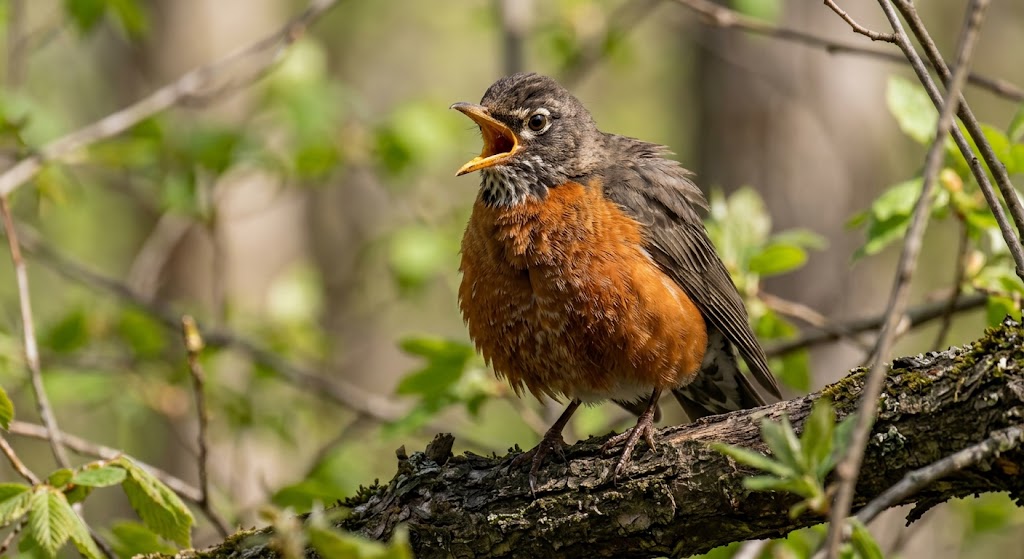
I was sitting in the backyard this morning with a cup of coffee, doing absolutely nothing of consequence, which is generally when the best questions show up.
It’s late summer edging into early fall, and the neighborhood was doing its usual nature things. There was the rustling of leaves, the occasional insect making an inexplicable amount of noise for something that weighs approximately three molecules, and birds doing what birds do.
Then one bird started singing. And I mean singing.
This wasn’t a quick tweet-tweet, good morning, everybody and then off to conduct some important bird business. This bird had apparently booked the backyard for a solo engagement.
He’d launch into a verse, keep going for several minutes, take a brief pause, and then immediately return for a second verse. Then a third. Then, apparently feeling that the audience had not yet fully appreciated his artistic vision, a fourth.
Meanwhile, the other birds in the neighborhood were conspicuously absent from the conversation.
Which got me wondering:
Are birds ever annoyed by other birds?
Not threatened. Not challenged. Not territorially concerned.
Annoyed.
Does some other bird sitting ten yards away ever hear this prolonged avian soliloquy and think:
Jesus Christ, Harold. We heard you the first time.
Obviously, we can’t know what a bird is thinking in the same way we can know what a person is thinking. There probably isn’t a tiny bird psychologist sitting in the shrubbery taking notes on Harold’s interpersonal deficiencies.
But here’s where things get interesting. Birdsong isn’t merely background music.
For many songbirds, singing is part of the machinery of territory, courtship and competition. A male may be advertising himself to potential mates while simultaneously telling other males that a particular patch of real estate is occupied. And when another bird answers, that exchange can become something considerably more serious than two guys harmonizing across the neighborhood.
Researchers actually have a name for one particularly interesting version of this interaction: countersinging.
Basically, one bird sings and another bird responds. Which sounds innocent enough until you discover that researchers have found pretty convincing evidence that, in some species, countersinging can function as an aggressive signal.
One study of Carolina wrens found that males were more likely to countersing when they were highly aroused by a territorial intrusion. More importantly, the wrens responded more aggressively to countersinging than to singing that wasn’t part of an exchange. In other words, the bird equivalent of “Oh, we’re doing this now?” appears to be a real thing.
And it can get even more pointed.
Birds don’t necessarily just take turns singing. Sometimes they deliberately overlap each other’s songs.
That’s potentially significant because the timing of a bird’s response can communicate how willing it is to escalate an encounter. Experiments with territorial blue tits, for example, have found that overlapping an opponent’s song can be associated with a greater willingness to escalate than simply waiting politely for the other bird to finish.
Which gives a whole new meaning to interrupting someone.
Imagine two birds:
Bird #1: CHEE-DEE-DEE-DEE-DEE-DEE-DEE—
Bird #2: CHEE—
Bird #1: —DEEE-DEE-DEE-DEE—
Bird #2: I’M SINGING HERE.
At least, that’s probably how I’d interpret it if I were irresponsibly anthropomorphizing the situation.
And scientists have gone considerably further than simply listening to birds yell at one another. Researchers studying banded wrens have documented territorial interactions in which neighboring males change their singing patterns as they approach one another.
The birds can match song types, alter the diversity and timing of their songs, and eventually escalate from countersinging to other aggressive vocalizations and, in some cases, physical confrontation. The singing appears to function as a sort of negotiation over territory—essentially giving the birds several opportunities to determine who is willing to back down before somebody has to actually throw feathers.
That’s a fascinating distinction. Because from our perspective, a bird sitting in a tree and singing its little heart out sounds like it’s simply enjoying itself.
But to another bird, the same performance might amount to something more like:
“This is my neighborhood. I live here. I am extremely confident about that fact. Please adjust your plans accordingly.”
And apparently, the duration of the performance can matter, too.
In experiments with territorial ortolan buntings, males responded more strongly to longer songs than to normal-length songs. The researchers interpreted song duration as potentially communicating the singer’s aggressive motivation.
So tody’s particularly enthusiastic backyard vocalist may have been doing more than entertaining himself.
He may have been making a point.
Of course, there’s an important wrinkle here: not every bird singing for several minutes is picking a fight. Birds sing for multiple reasons, and prolonged singing can be completely routine. A bird may be attracting a mate, maintaining a territory, practicing its repertoire, communicating with neighbors, or simply engaging in normal seasonal behavior.
And birds aren’t all operating under the same social rules.
Some species are remarkably territorial. Others are considerably more tolerant of their neighbors. Some recognize individual neighbors and respond differently to familiar birds than to strangers. In banded wrens, for example, researchers have found that resident males can distinguish familiar neighboring males from unfamiliar intruders and respond more aggressively to the latter.
Which means the bird next door isn’t necessarily thinking:
“I hate that guy.”
It might actually be thinking:
“Oh, that’s Frank. Frank always sings like this. Whatever.”
Until Frank crosses the line. And that’s where the whole thing becomes wonderfully relatable.
Because there appears to be a difference between having an annoying neighbor and having an annoying neighbor who starts encroaching on your property.
Researchers have even observed that birds can change their behavior based on previous interactions with specific neighbors. Song sparrows, for example, have been shown to respond more aggressively to a neighbor who had previously intruded into their territory than to a neutral neighbor.
So maybe the neighborhood birds aren’t sitting around judging the vocal abilities of our hypothetical backyard tenor. But maybe they are keeping records.
“That’s Harold. He’s loud, but he’s always been on his side of the hedge.”
“Yeah, leave Harold alone.”
“Wait. Is he singing from the maple?”
“The other maple?”
“Yep.”
“Oh, for fuck’s sake.”
And then somebody flies over to have a conversation. Not necessarily a friendly one.
So… are birds annoying to each other?
Probably not in precisely the way humans are annoyed by each other.
We have no evidence that birds are sitting around experiencing the particular psychological torment of hearing a neighbor’s lawn mower at 7:15 on a Saturday morning.
But birds absolutely do react to one another’s vocalizations, and those reactions can range from simple replies to highly structured territorial contests. In some species, the timing, duration, repetition, matching, and overlapping of songs can provide information about aggression and willingness to escalate.
So the next time you’re sitting outside and one bird starts absolutely monopolizing the airwaves, there’s a decent chance that at least some of the surrounding birds are paying attention.
Whether they’re thinking “What a beautiful song” or “If this asshole starts verse five, I’m going over there” is something science hasn’t quite settled.
And frankly, that’s probably for the best.
Some questions are more fun when we don’t know exactly what the answer is.
Although if my backyard vocalist starts a fifth verse tomorrow, I’m going to assume the neighbors have already begun organizing.