
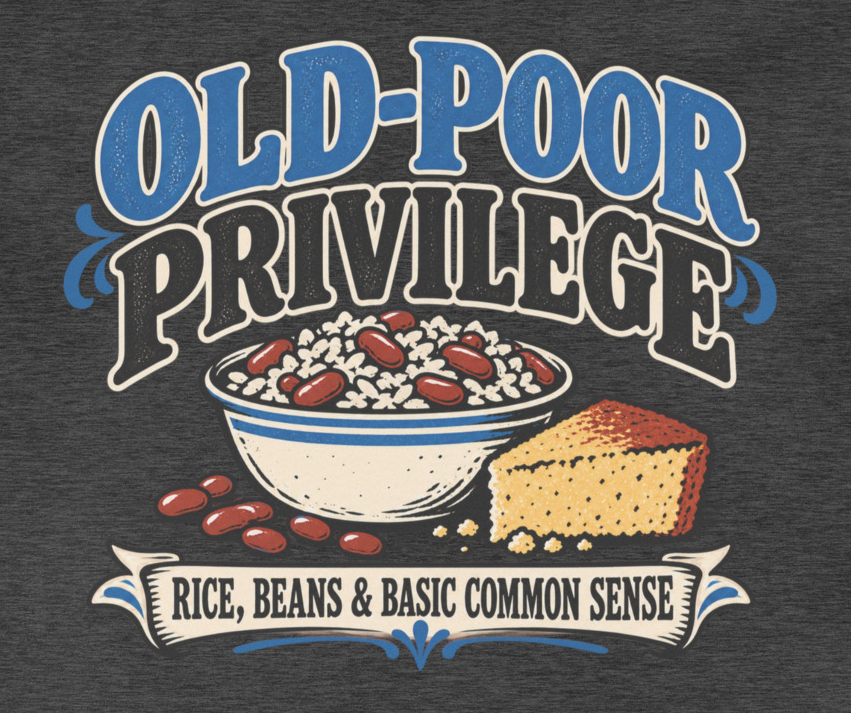
Rice, beans, and basic common sense.
There’s a new class of poor people emerging in America, and apparently, they’re having a hard time of it.
Not that being poor has ever been particularly easy. But as a friend of mine recently pointed out, there’s an important distinction between the New Poors and the Old Poors.
The New Poors are discovering poverty.
The Old Poors wrote the manual.
My friend was expressing some frustration with the growing chorus of people lamenting the cost of everyday necessities. Gasoline, groceries, utilities, household supplies. The usual suspects. People who, until recently, could afford to purchase things without conducting a preliminary financial investigation are suddenly discovering that the price of just about everything has become personally offensive. And they’re panicking.
To be fair, there’s plenty to panic about. When the cost of living outruns the means of living, things get uncomfortable in a hurry. Nobody enjoys watching their grocery budget shrink while the groceries themselves get more expensive.
But my friend wasn’t particularly sympathetic to the learning curve. You see, the Old Poors have been doing this for years.
Welcome to the Poverty Orientation Program
The New Poors are having to learn things that the Old Poors have known practically since birth.
Like:
- How to soak dried beans.
- How to turn a bag of rice into several meals.
- How to stretch leftovers into something that doesn’t immediately announce itself as leftovers.
- How to prepare your own taxes without paying someone a hundred dollars to tell the government you don’t have any money.
- How to compare unit prices instead of package prices.
- How to distinguish between something being on sale and something actually being affordable.
- How to recognize that a convenience fee is often just a surcharge for not having planned ahead.
And perhaps most importantly,
- How to accept that occasionally the answer to “Can I afford this?” is simply “No.”
These aren’t revolutionary discoveries. They’re ordinary survival skills, developed through years of necessity and passed along through generations of people who never had the luxury of considering them optional.
The New Poors are watching instructional videos.
The Old Poors are wondering why anybody needed instructions.
My friend even described an AI-generated video featuring an artificial Mexican grandmother dispensing kitchen wisdom about saving money. This is a particularly fascinating development: we’ve apparently reached the point where artificial intelligence is being enlisted to teach people how to be poor. Somewhere, a real grandmother is shaking her head and wondering why anybody needed a computer to explain a pot of beans.
And as my friend subsequently pointed out, proper bean-soaking is not merely a matter of culinary convenience. It’s a matter of dental economics. Because if you don’t know what you’re doing, you’ll end up chipping a tooth on a still-dry bean.
And then you’ve got a whole new financial problem. You couldn’t afford groceries, so you bought dried beans to save money. Now you need dental work you can’t afford either. Congratulations. You’ve converted a budget-friendly meal into an unsecured dental liability.
The Old Poors know that the cheapest meal isn’t necessarily the cheapest meal if you have to finance a crown afterward. They also know to soak the beans, cook them thoroughly, and keep an eye out for the occasional stray pebble.
That last one is particularly important. Beans are supposed to be economical. They shouldn’t require a dental insurance rider.
A Different Kind of Privilege
That’s the point in the conversation where my friend introduced me to the phrase that eventually became this design:
Old-Poor Privilege.
And I rather liked it, because it takes the familiar language of privilege and turns it slightly sideways.
Ordinarily, privilege describes an advantage gained through circumstances that other people haven’t enjoyed. Wealth, opportunity, access, social standing: the sort of advantages that make life easier without necessarily requiring the beneficiary to recognize them.
But what happens when the advantage is having already experienced the disadvantage? What if growing up without much money leaves you unusually well equipped to continue not having much money?
The Old Poors know which generic brands are perfectly acceptable and which ones represent an unforgivable compromise. They know that a pound of dried beans goes considerably further than a can of prepared beans. They know how much water to add to a pot of rice without consulting the internet.
They’ve developed a particular familiarity with stretching dollars, improvising meals, and distinguishing between necessities and things that would be awfully nice to have.
They know how to make do. And, more significantly, they’ve learned how to make do without having to make a public announcement about it.
That, I suppose, is the privilege. Not having more resources. Having more experience with fewer.
Of course, this isn’t to suggest that poverty is some wonderful character-building opportunity that everyone ought to experience. There’s nothing especially noble about going without necessities, and nobody should have to develop survival skills simply to keep themselves fed.
Nor does every person who grew up poor automatically possess exemplary financial judgment. Poverty doesn’t confer wisdom by divine appointment. And an unexpected financial crisis can overwhelm even the most resourceful household.
But experience does count for something.
An Old Poor may not have a larger financial cushion than a New Poor, but there’s a good chance they’ve developed a few more ways to cushion the fall.
Rice, Beans, and the Cornbread Controversy
Naturally, once the phrase Old-Poor Privilege had established itself, I began thinking about how to turn it into a Spare Thoughts design.
The obvious imagery was rice and beans. Simple, recognizable, economical, and practically the unofficial culinary emblem of getting by.
Then came cornbread. And with cornbread came a surprisingly firm brand preference.
My friend made it abundantly clear that no design representing her philosophy of Old-Poor Privilege should include anything resembling that Yankee Jiffy brand. She is, apparently, a Gladiola loyalist.
Not merely someone who prefers Gladiola. A supporter.
There are certain loyalties in Southern kitchens that transcend ordinary consumer preference. They are matters of heritage, upbringing, tradition, and occasionally outright territorial hostility. Apparently, cornbread mix belongs among them.
I found that particularly amusing because it illustrates another distinction between the New Poors and the Old Poors.
The New Poors might approach the cornbread aisle wondering which box offers the best value.
The Old Poors already know which one they’re buying, and may regard suggestions otherwise as a personal insult.
Economizing, it turns out, doesn’t necessarily mean abandoning one’s principles. Especially where cornbread is concerned.
The Design Takes Shape
The first design concept was rather elaborate: a vintage-style poster with bold typography, a bowl of rice and beans, dry beans in a jar, cornbread, and an old-fashioned Southern kitchen atmosphere. It was a respectable illustration, but it felt more like something you’d hang in a kitchen than something you’d wear on a shirt.
So I started stripping it back. Less poster, more proclamation. I also decided that Old-Poor needed a hyphen.
There’s a useful distinction there. We’re not celebrating the privilege of being old, poor, and possibly both. We’re identifying a specific cultural and economic condition: the advantage of having been poor long enough to know what you’re doing.
Old-Poor is an acquired status. The hyphen makes it official.
The revised design uses the phrase OLD-POOR PRIVILEGE as its centerpiece, accompanied by a simple bowl of rice and beans, a modest piece of cornbread, and the supporting declaration:
RICE, BEANS & BASIC COMMON SENSE
I wanted something that could work as a straightforward, limited-color print on a T-shirt. No elaborate background, no sprawling kitchen scene, no unnecessarily expensive visual flourishes. A design about economical living shouldn’t require a small fortune in printing techniques to reproduce.
And, out of respect for the aforementioned Southern culinary convictions, there is no Jiffy box anywhere in sight.
Experience: The One Thing You Can’t Buy in Bulk
The more I thought about Old-Poor Privilege, the more I appreciated the contradiction at its center.
We generally think of experience as something that makes us better equipped for whatever comes next: professional experience, parenting experience, mechanical experience, life experience. But we seldom celebrate the particular expertise developed by consistently having to live within narrow financial margins.
There’s an entire practical education that comes from not having enough.
It teaches prioritization. Resourcefulness. Patience. Occasionally creativity. And, perhaps most importantly, the ability to recognize the difference between an inconvenience and an actual emergency.
For someone accustomed to financial comfort, having to plan meals around sale prices may feel like an alarming reduction in quality of life. For someone who’s been doing it for decades, that’s just Tuesday.
The difference isn’t necessarily in the severity of the circumstances. It’s in their familiarity.
And that’s where the humor in Old-Poor Privilege really lives.
The Old Poors aren’t laughing because the New Poors are struggling (at least, I hope not). They’re laughing because the New Poors are discovering things that the Old Poors never had the option of not knowing.
There’s a peculiar satisfaction in watching some hard-earned bit of ordinary knowledge suddenly become fashionable advice. You spent half your life being told that you needed to improve your circumstances, only to discover that those same circumstances have prepared you to instruct everyone else.
Apparently, you’ve been developing marketable expertise all along. Who knew?
A Privilege Nobody Asked For
I don’t imagine many people would voluntarily enroll in a lifetime of economic hardship just to acquire the ability to stretch a sack of rice. And the ultimate goal, presumably, is for everyone to have enough financial security that knowing how to survive on next to nothing becomes a useful skill rather than a daily requirement.
But until that glorious day arrives, there remains something worth recognizing in the people who’ve been quietly navigating these realities for years.
They may not have inherited wealth or have impressive investment portfolios.
They may not have the disposable income to buy groceries without checking the bank balance first.
But they know how to soak beans. They can file their own taxes. They know how to make a meal out of what happens to be in the pantry. And they know that when somebody tells you to tighten your belt, it’s helpful if you’ve already learned how to punch another hole in it.
That’s Old-Poor Privilege.
It isn’t the privilege of having plenty. It’s the privilege of knowing what to do when you don’t.
And if you plan on serving cornbread with your rice and beans, you’d better make damn-well sure you’re using the right mix.


